
Garden Design
HART Student Housing Village
A native planting design for the homes at Oak Hills Church, Folsom.
Site: Oak Hills Church campus, 1100 Blue Ravine Road, Folsom CA
For: HART of Folsom
Homes: Units A through F
Designed by: Little Garden Things
01 / The Design Vision
Calm green at the center, native life at the edges
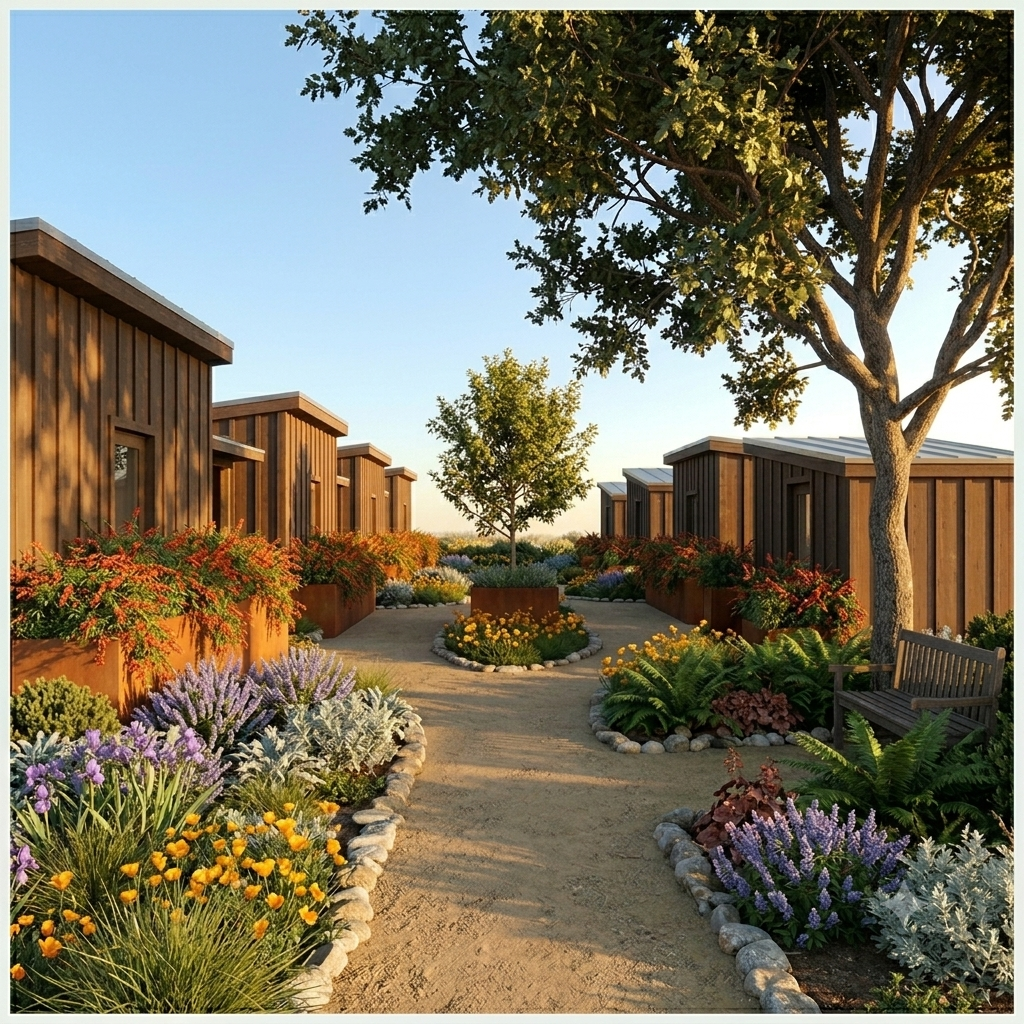
Six modular homes, Units A through F, wrap a decomposed-granite courtyard. The planting gives that courtyard a feeling of home. It stays green and quiet where people live and sit, and carries native color and habitat out toward the edges.
Every plant is a California native chosen for the Folsom foothills: hot dry summers, mild wet winters, real fire risk, water worth saving. The garden gets calmer and safer as it nears the homes, livelier as it moves out. That one move answers three things at once. It keeps the planting low and green against the warm buildings. It keeps bees away from doors and seating. It keeps fuel off the structures. One logic, three results.
At the homes
Weathering-steel planters run along the unit fronts, set on the river-rock strip already in the civil plan. The rust tone sits easily against the brown buildings and the brown church grounds. Planted with California fuchsia that spills into the rock and turns red-orange in late summer, they bring color to the doors. These are hummingbird plants, so there is bloom at the windows without bees at the thresholds.
The sensory garden
A small sensory garden tucks into a quiet pocket between two homes. It is built for the senses: aromatic sage and yarrow to smell, soft fern and coral bells to touch, cool blooms and silver foliage to rest the eye, shade overhead. Green and foliage carry it, not grasses, so it stands clear of the brown buildings. Seating stays level and the planting stays low, so the view across stays open.
The walkway spine
Along the decomposed-granite path that links the homes, planting fills the pockets between entries. Evergreen manzanita gives year-round structure and mahogany bark, set back from the doorways. California fuchsia carries color down the path, and hummingbird sage scents the shadier corners.
The perimeter
Out at the new perimeter fence, away from seating and walls, the pollinator planting lives: California buckwheat, Cleveland sage, narrowleaf milkweed for the monarchs, poppies. This is the one place a native bunchgrass earns a spot, for habitat. The belt doubles as the outer fire-wise zone, planted with space between.
The plant palette
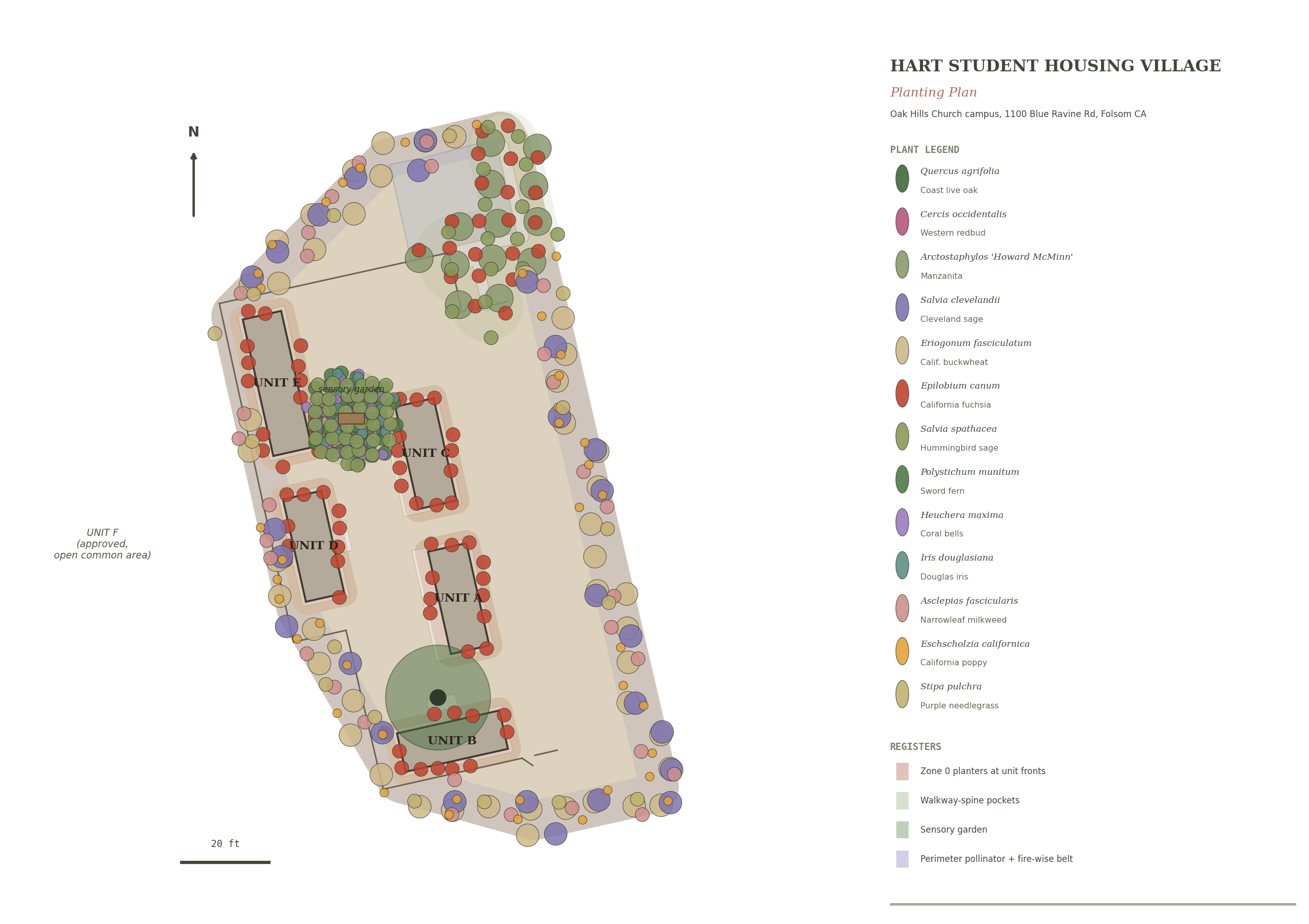
All California natives, low water, low upkeep once established. Pollinator value is listed because it sets placement. The bee plants stay at the perimeter, never at the seating or the doors.
| Plant | Common name | Role | Pollinator |
|---|---|---|---|
| Polystichum munitum | Western sword fern | Evergreen green texture, shade, no flowers | None |
| Heuchera maxima | Island coral bells | Evergreen mound, airy bloom | Hummingbird |
| Iris douglasiana | Douglas iris | Green strappy texture in place of grass | Low |
| Salvia spathacea | Hummingbird sage | Aromatic groundcover for scent | Hummingbird |
| Plant | Common name | Role | Pollinator |
|---|---|---|---|
| Epilobium canum | California fuchsia | Red-orange late summer, cascades into the rock | Hummingbird |
| Arctostaphylos 'Emerald Carpet' | Trailing manzanita | Evergreen green spill, minimal flower | Low |
| Heuchera maxima | Island coral bells | Green mound for the shaded ends | Hummingbird |
| Plant | Common name | Role | Pollinator |
|---|---|---|---|
| Arctostaphylos 'Howard McMinn' | Manzanita | Evergreen structure, bark contrast, set off doorways | Bees, hummingbirds |
| Epilobium canum | California fuchsia | Color along the path | Hummingbird |
| Salvia spathacea | Hummingbird sage | Aromatic understory in shadier pockets | Hummingbird |
| Plant | Common name | Role | Pollinator |
|---|---|---|---|
| Eriogonum fasciculatum | California buckwheat | Backbone pollinator, very low water | Bees, butterflies |
| Salvia clevelandii | Cleveland sage | Aromatic, spaced for fire-wise | Bees, hummingbirds |
| Asclepias fascicularis | Narrowleaf milkweed | Monarch host plant | Monarchs, bees |
| Eschscholzia californica | California poppy | Color, self-sows | Bees |
| Stipa pulchra | Purple needlegrass | Habitat. The one grass, kept at the edge | Wind |
| Plant | Common name | Role |
|---|---|---|
| Cercis occidentalis | Western redbud | Spring magenta, bare in winter to let sun through, set off the seating |
| Quercus lobata or Q. agrifolia | Valley or coast live oak | Primary canopy for shade. Slow to establish; built shade is the day-one alternative |
02 / Site Microclimates and Strategic Response
The design answers the land it sits on
The brown buildings hold heat. Their walls warm through the Folsom afternoon. The front planters take heat-tolerant, low-fuel plants, and canopy trees pull the temperature down where people gather.
The courtyard is open and bright. The decomposed-granite spine runs through full sun, so planting concentrates in the pockets and edges, keeping the route clear and the water where the plants are.
Shade is scarce. The survey shows few existing trees and one slated for removal. New canopy is the long game, with built shade available if HART wants usable shade from day one.
The site sits in the foothills. Hot dry summers and fire risk shape every choice: drought-tolerant natives, spacing, and a non-combustible zone against the homes.
The homes face into the courtyard. Sightlines across the space matter for a residential community, so planting near seating and paths stays low and the view stays open.
03 / Technical Execution and Sustainability
Built to last and to tread lightly
Soil and health foundation
Foothill ground here runs to clay and decomposed granite, draining unevenly. Beds are amended for steady drainage, because California natives fail faster from wet feet than from drought. Right plant, right place does the rest. Mulch is organic in the planted beds and mineral gravel in the zone against the buildings, where bark would be fuel.
Fire-wise safety
The design treats Cal-Fire's zero-to-five-foot ember-resistant zone as a feature. The civil plan already draws a five-foot non-combustible gravel strip around the homes. Nothing is planted in the ground against the walls. The weathering-steel planters hold the front planting in elevated containers over that gravel, so the greenery stays high-moisture and the ground stays clear of fuel. Higher-fuel natives like manzanita and Ceanothus are spaced and kept toward the perimeter, away from the structures.
Smart irrigation
The civil plan places eight new potable-water points across the site. Those are the irrigation tie-ins. Water runs on drip, zoned by area so each gets only what it needs. The planters and sensory garden carry regular water through establishment, then taper. The perimeter natives need little once their roots are down. A smart controller adjusts to the season. After the first year or two, this garden mostly waters itself.
8 new potable-water tie-ins on the civil plan
5-foot non-combustible Zone 0 at the homes
100 percent California native palette
04 / Maintenance and Accessibility
Low upkeep, and accessible by design
Built for low, predictable upkeep
The palette establishes and then settles. The heavy work is the first two years, while roots take hold. After that the rhythm is light and seasonal: a cut-back of the fuchsia and sage in late winter, a drip check in spring, light tidying through summer, a leaf and mulch pass in fall. Native plants in the right spot do not ask for much.
Accessibility built in
Accessibility is a strength of this design, present from the start. The planting follows the accessible routes the civil plan establishes, with their ramps and landings, and never crowds them. Seating stays level and the planting around it stays low, so sightlines are open and the space reads as safe. Paths are kept clear of anything that grabs or trips, with no thorns where people brush past. The raised planters bring greenery, scent, and color to seated eye height and within easy reach.
Phasing
The planting phases to match the construction, including the sixth home, Unit F, in the west common area, so nothing goes in the ground only to be torn up later.